
Identity:
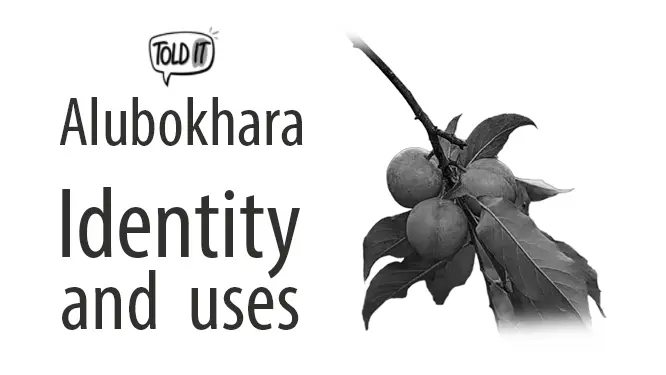
This is a type of shrub-like tree, somewhat similar in appearance to a small bakul tree. The foliage is bushy, and the leaves are shaped like small ovals. The edges of the leaves are serrated, and some trees even have thorns.
This fruit is cultivated in various regions of the Himalayas at elevations of five to seven thousand feet.
Uses:
The fruit of the alubokhara, its seed oil, and the bark of its root are used to make medicines. In the months of Poush and Magh, the tree produces clusters of white and pink flowers. Fruits appear in the months of Falgun and Chaitra.
The fruit is round like a potato, with a smooth maroon surface. When unripe, the fruit is tart; when ripe, it becomes sweet-and-sour. The fruit is dried and exported abroad.
Alubokhara has several medicinal properties—it helps reduce bile-related disorders, stimulates digestion, relieves fever-related fatigue, and quenches thirst.
For loss of appetite, the fruit should be soaked in warm water for several hours, mixed with a little sugar, and consumed as a sherbet. It should be eaten after removing the skin, which helps improve appetite.
When fully ripe, this fruit does not harm the body in any way. People with predominantly vāta (airy), pitta (fiery), or kapha (phlegmatic) constitutions can all safely consume it.
